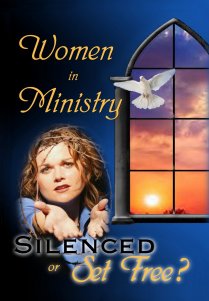
Women in Ministry Silenced or Set Free?

This blog is for questions and answers on our DVD entitled "Women in Ministry Silenced or Set Free?" This 4 DVD set answers the hard passages of scripture that seem to restrict women's ministry. If you would like to purchase a video click here.

Sunday, March 19, 2006

Isn't it a sin for a woman to teach men?

Q: Doesn't Paul's command in 1 Timothy 2:12 for women not to teach men show that to disobey this command is a sin?

A: That's a great question. In 1 Timothy 2:12 we need to determine what the command is and who the command is to. To determine these two things, we refer you back to the section on 1 Timothy 2:12 in the DVD "Women in Ministry Silenced or Set Free?" Now to the question about sin. If one interprets this passage as meaning that all women are not allowed to teach the bible to men, then one would have a very serious dilemma about the charge of sin in this passage. The dilemma is that every single sin that is enunciated in scripture is always confirmed at least once. The reason is that there must be at least two or three witnesses for a matter to be established (Deut. 19:15; 2 Cor. 13:1). So, let's look at scripture. Is there any confirmation in scripture that lists women teaching the bible to men as a sin? No. There is not even one place in scripture that says that a woman who teaches the bible to men is in sin. Why is this important? The reason that this is so important is that to impute sin to a woman for merely teaching God's word to men is a very serious matter. God never violates his word and he has already told us that in the matter of sin, there must be at least two witnesses. Yet there is no second witness about this "sin". If there is no second witness about the sin charged to a woman for her disobedience by teaching men, then either God's word goofed on this one or the interpretation that women are commanded by God to not teach the bible to men is not accurate. We submit that God's Word did not make a mistake. The fact that there is no second scripture that charges women with sin by teaching the bible to men proves that this interpretation cannot be right. For those of our brothers in Christ who believe that Paul is commanding something for all women to abstain from or be charged with sin, we simply ask them to prove from scripture the second witness or withdraw the accusation of sin to women who are part of the body of Christ but whom God has called to teach the entire body of Christ.

Monday, March 13, 2006

Isn't "a woman" from 1 Timothy 2 clear that she is "generic woman"?

Q: You say that “a woman” in 1 Timothy 2:11 & 12 is the same terminology as Paul calling “a man” living in sin in 1 Corinthians 5. Wouldn’t you have to admit that the normal grammatical reading in 1 Corinthians 5 which says that Paul is talking about a particular man, not “all men”, is clearer there than in the passage in 1 Timothy 2 talking about “a woman” not meaning “all women”?

A: Absolutely, yes, I agree. That is why the 1 Corinthian 5 passage is not considered a difficult passage. 1 Timothy 2 has many difficult elements and it has been considered a difficult passage throughout church history. However for one to insist that “a woman” is generic woman or “all women” in verses 11 & 12 one would have to disregard the clear tie that Paul makes to the first deceived woman in verse 14 & his indisputable reference to “she” in verse 15. We choose not to disregard any part of the passage or any part of the grammar and we believe that the entire passage is inspired with the exact words and grammar that the Holy Spirit wanted to convey to show that “a woman” is a single deceived woman in Ephesus.

Why do you say that animals were created after Adam?

Q: In your section on 1 Timothy 2, you state that Adam saw some of the animals being created, perhaps the mates of the animals already created on day six. However, says that God had formed "all of the beasts" (NIV) or "every beast" (NASB). Wouldn’t you say that it's a stretch to say that means "some" animals were formed when Genesis says that God formed every beast?

A: As we documented in WIM from Hebrew scholars, Genesis shows a second creation of the animals after Adam was created. Although these could have been the mates to the animals created earlier in the day, it certainly could have been both male and female of all of the kinds of animals. We do know that every animal was created after Adam and the point that we make is not which animals are created after Adam (whether they are male or female or both) but the fact that there are animals created after Adam allowing him to be the only one in all of human history to see creation first-hand.

Q: You make mention that it's likely the animals Adam saw created were the mates because on day six in chapter 1 the animals were not told to be fruitful and multiply. However, the birds created on day five were told to "be fruitful and increase in number". The birds are referred to in the same breath as the beasts: "Now the LORD God had formed...all the beasts of the field and all the birds of the air." How can we differentiate between the two when the verse itself doesn't?

A: This verse doesn't differentiate between the two, but the actions of God after their original creation does differentiate them (birds were told to be fruitful, but the animals were not). However for the point of argument, we will stick to what we know from scripture not what we can speculate. We know for sure from Genesis 2:19 that God formed these animals and then (the wording connects the next action) brought them to Adam. These were not the exact same animals that God originally spoke into existence in chapter one although they are the same kinds of animals. God created all kinds of animals at the beginning of day 6 and then created more of the same kind after Adam. This is not too hard to understand at all. After all God did the same thing with humans. God created the first of the kind of humans (the man) and then much later in the day he created the same kind (human) but in a different way (from Adam's side - not from the dirt). If God did a separate creation of the same kind in two different creative acts with humans, surely it cannot be hard to conceive that God can do the same thing with the animals (as He says he did). The original animals were not formed by God from the dirt but were spoken into existence. The second set of animals (of the same kind) were created differently. They were formed from the dirt and then brought directly to Adam. This we know from scripture and there is no contradiction here, just a similar action with the animals as God does shortly with man. Creation at different times and in different ways

Would your arguments have strength without 1 Timothy 2:15?

Q: It also seems that 1 Timothy 2:15 is crucial for your interpretation. The word 'she' is a definite point in your favor. However, without this verse (being that it's very difficult historically) do you think you'd have the strength in your argument as you do now?

A: Yes, 1 Timothy 2:15 is a very strong point in our argument. It is very important because Paul draws all his conclusions that he has systematically defended in the previous verses, and ties them all together in this one verse. Many Pastors will be blunt and say that they have no idea why Paul put this verse in the passage. When tradition is held to instead of a systematic verse-by-verse exegesis, this verse sticks out like a sore thumb. The fact that one cannot find any person to attach the “she” to from verse 15 unless one interprets verses 11 & 12 as a single woman in the congregation is highly important. You are correct in the fact that the Holy Spirit inspired both the “she” and the “they” in verse 15 and this has been ignored in church history. Without this understanding verse 15 has been deemed confusing and out of place in the context. However when we can find a person to attach the “she” to, the passage all of a sudden starts to make perfect sense in the complete context of chapters 1 and 2 of 1 Timothy.

However with all of that said, the question you asked is if our argument would not be as strong an argument without the grammar from verse 15. Without this verse (the conclusion that Paul draws to his previous statements) we would have to rely solely on the fact that the traditional interpretation of 'a woman' being generic woman, or all women past, present and future, causes the passage to contradict other clear passages and it has caused a very unhealthy tradition or attitude in the church. John Piper brings it out very succinctly. He says that up until about 15 years ago, this passage was interpreted as meaning that women were created as ones who are easily deceived. Yet, that is not even holding to the passage in the proper literal sense. Paul didn't say Eve was deceivable. He said that Eve was deceived. Therefore to hold to the literal interpretation, if Paul meant 'a woman' to be 'all' women, we would have to hold to the teaching that all women are deceived and therefore not to be relied on for doctrinal integrity. If Paul meant deceivable he certainly would have said that. The key point is that scripture is talking about someone who is deceived not someone who is defective and thus could be easily deceived. I say let's just stick to scripture and not make it say what we want it to say. It says 'deceived' and the Holy Spirit gives us the end result of this deception, as far as the salvation of the deceived goes, in verse 15.

Wasn't the garden created before Adam was created?

Q: Doesn’t Genesis 2:8 simply say that God had already planted a garden and then put man into it after he was formed? Don’t the following verses then go on to describe what the garden was composed of, not a sequential account of the garden being formed after the man? If 2:8 says there was a garden that God put man in, but he hadn't yet created the vegetation for it, how could it be called a garden? It's not a garden until we see green stuff. But as a summary statement, it is simple to see that the vegetation and animals and garden were all in place, and then God put man in it. Adam didn't witness it.

A: A garden is a garden not because of the green stuff that you see, but because of what has been planted. We can see that very clearly even today. I can go out into my back yard and prepare the soil and plant a garden. My neighbor won’t come by and tell me that I haven’t planted a garden just because he can’t see any green stuff. The fact that it is called a garden even before the green vegetation is seen.

Now regarding your statement that Genesis 2:8 is a summary statement of what has already happened, that is not possible in the Hebrew construction. There is no mention of the garden before. Now remember that this is not my interpretation but is the precise grammar of the Hebrew and is explained very clearly in the book “Biblical Hebrew and Discourse Linguistics” that I quoted in WIM. This book was written by Bible translators and I think their understanding of Hebrew should be pretty good, don't you think? This book came as a result of a seminar that was held on Discourse Linguistics and Biblical Hebrew in Dallas, Texas in June 1993. Of the ninety or so persons present, about sixty were working translators, members of Wycliffe Bible Translators and other societies, whose main vocation is translating the Bible into languages (often of peoples not yet literate) in various part of the world....The other thirty participants were linguists and biblical scholars from all over the world. I think that we should be able to trust the grammar of these 90 scholars who make their living translating the Bible.

Another very important resource is the Septuagint. The Septuagint was the Greek translation of the Hebrew bible. It was produced a few hundred years before Christ and was often quoted by Christ and his disciples. In the English version of the Septuagint we can clearly see that the translation of the Hebrew shows a subsequent creation of both plants and animals after Adam’s creation. In Genesis 2:8 it says

And God planted a garden eastward in Eden, and He placed the man there whom He had formed.
It is clear from this translation that man had already been formed when God planted the garden. The formation of animals after Adam is also clear. In Genesis 2:19 it says:

And God formed yet farther out of the earth all the wild beasts of the field, and all the birds of the sky, and He brought them to Adam, to see what he would call them, and whatever Adam called any living creature, that was its name.

It is clear from the Septuagint that the animals were “formed yet farther” (a second act of animal creation) out of the earth after Adam’s creation and the garden was planted after Adam was created.

If you would like to see the English copy of the Septuagint on Genesis 2 you can access it here
http://www.apostlesbible.com/books/g01genesis/g01c02.pdf

Sunday, March 12, 2006

Is there no distinction between male and female?

Q: Some feminists say that there is no distinction to be made between male and female. Is this what you believe?

A: One of the biggest deceptions that Satan has brought into the women's issue is that equality = sameness. That is not what we believe or teach. You may have noticed in the last section of WIM that I say that equality does not mean unisex. Women are different than men and that is the way that God planned it. Woman was created to meet a man's need. Men need women because women are different than men and were made to complement him and to complete him. A man and a woman together in marriage are a union of two equals but not a union of two of the exact same things. Women think differently, react differently and have different emotional needs. Satan has confused matters by bringing ungodly women into the secular women's movement who not only have hijacked that movement and taken it onto a pathway of evil but who usurp God's authority in creation and teach that men and women are the same. By their ungodly and unnatural teaching they uphold the sinful position of those who want to propagate same sex unions. Again the lie of the devil is that equality = sameness.

Saturday, March 11, 2006

Recommendations for WIM


Women in Ministry: Silenced or Set Free?" as a whole is a very well produced and presented multi-media teaching series on the legitimacy and freedom of women to be in any ministry that God should call them to. The instructor is knowledgeable, very presentable, and articulate. The series presents serious biblical exegesis and research on a number of texts that are often quoted as evidence that women's roles and opportunities in ministry are limited. Taken all together I find this series to be very relevant and helpful and therefore cannot be passed off lightly....This series can go a long way to giving women the freedom to pursue ministry as God calls them and to answer the concern and questions of others.

I can recommend MM Outreach ministries and would be privileged to do so.

-Rev. Robert Guthrie, B.Th. M.A. Instructor in Biblical Studies and Church History Vanguard College, Edmonton, Alberta


In a world where many secular societies have seen the equality and value of women in leadership roles, too often religions have been slow to make the same transition. Biblically, Christ "tore down the middle wall of partition" that separated men and women, yet still, many Christian denominations and organizations maintain an error-filled perspective concerning women in ministry. As "Women in Ministry Silenced or Set Free?" clearly exposes the truth of God's word, each individual who wants balanced instruction in this vital area of teaching will discover that God's word is not vague nor is it indifferent about the role of women and their God-given ministries.

Those who have felt confused or restrained will find instead great freedom and a sound stance that upholds truth and extends endorsement for all women who choose to serve Christ in leadership and teaching roles.

...(the) series was well-prepared and with good documentation! Well done!

-Pastor Wayne McNeilly/Evangel Pentecostal Assembly, Edmonton, Alberta, Canada


The story of creation tells us that both man and woman were made in the image of God. All people are given intrinsic value in the miraculous act of creation, and all people are loved passionately by God, regardless of gender, race, age, education, economics, etc. However, though men and women are equal in value and purpose in God’s eyes, there are passages in the Bible that raise the question of whether or not God limits the roles that are available to women in a local church family. Women in Ministry: Silenced or Set Free examines this question in a thoughtful and persuasive way. Through clear, concise teaching and multimedia, this series provides an excellent presentation of the arguments in favor of a woman’s freedom to serve in all roles of Christian leadership according to God’s leading. Though I disagree with the theological conclusions of this series at several points, I found the series very helpful in understanding the issues involved from a different perspective. Without a doubt, the presentation is offered with tremendous respect, integrity, and grace.

Dr. Scott Heine, Compass Church, Goodyear, Arizona


Women in Ministry is a well-researched, well-presented series on the role of women in the church today. Cheryl Schatz has done her homework in a very thorough and thought-provoking manner. She brings to our attention the pertinent scriptural teaching that helps us see the freedom women are given by the Lord for leadership in the church and the exercise of their God-given spiritual gifts.

The material is presented in an engaging format. From the very beginning the viewer is drawn in with excellent graphics and video clips. Cheryl is a gifted Bible teacher.

This series is a must-see for those who seriously want to know what the Bible teaches on the role of women in the church today.

Rev. Bob Carroll
Church Planting Pastor
The Link Christian Community
Edmonton, Alberta


Scriptures Showing Women in the Ministry are Missing

Q: Why did you not list in WIM all the scriptures that show women properly leading and serving God in both the New Testament and the Old Testament?
A: This DVD set is specifically about the hard passages of scripture that seem to restrict women from ministering to the entire body of Christ. Although listing all the scriptures that show women's ability and calling to minister wherever God calls them is important, these scriptures alone do not adequately explain what appears to be a roadblock to women's ministry - namely the hard passages of scripture. WIM deals with all the hard passages in a way that makes them understandable and allows the scriptures to be read without contradiction.

Introduction

"Women in Ministry Silenced or Set Free?" (WIM) is a very visual way to learn to understand the hard passages of scripture concerning women in ministry. However I felt that it would also be helpful to have an interactive way to answer questions that have arisen from those who have viewed the DVD teaching series. This blog will give readers the ability to see what questions others have asked concerning WIM and the teaching on the hard passages of scripture.

If you have any comments or questions you may post them for others to see or for me to answer. I do expect that you will be courteous and dialogue in a respectful manner.